
Farm Tax Relief Program
Could your farmland be holding an overlooked tax deduction?
A specialized agricultural tax review may identify residual soil fertility and other qualifying value that existed when farmland was acquired—supported by testing, valuation, documentation, and professional tax review.
Specialized review forFarmers, ranchers & agricultural landowners
The first step is simply finding out whether a full agricultural study may make sense.
A preliminary look
Could your property qualify?
A review may be worthwhile for agricultural property used for row crops, orchards, vineyards, livestock, grazing, hay, forage, or other commercial production—especially when meaningful farming activity occurred before or after acquisition.
01You own agricultural property
02The land was purchased or otherwise acquired
03The property has supported active agricultural production
04Property and production records may be available
How the process works
A documented review from property facts to tax-professional evaluation.
Agricultural and soil analysis
Valuation and documentation
Tax-professional review
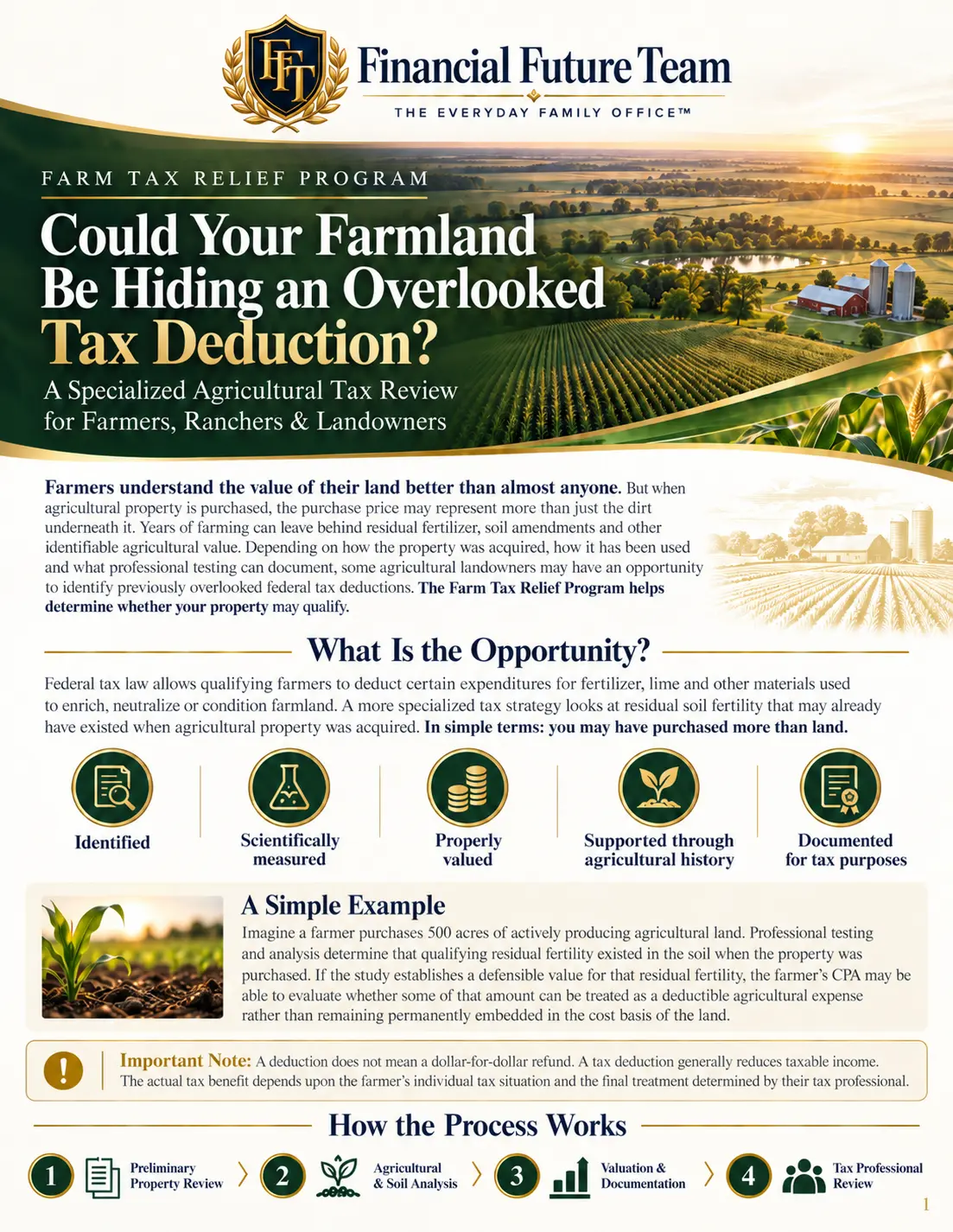
Four-page program guide
Review the opportunity, eligibility questions, and next steps.
Select any page to open the full-size version in a new tab.
 Open full-size page ↗
Page 1
The Opportunity
How residual soil fertility may represent an overlooked agricultural tax deduction.
 Open full-size page ↗
Page 2
Could Your Farm Qualify?
The ownership, production, restriction, and conservation questions used in a preliminary review.
 Open full-size page ↗
Page 3
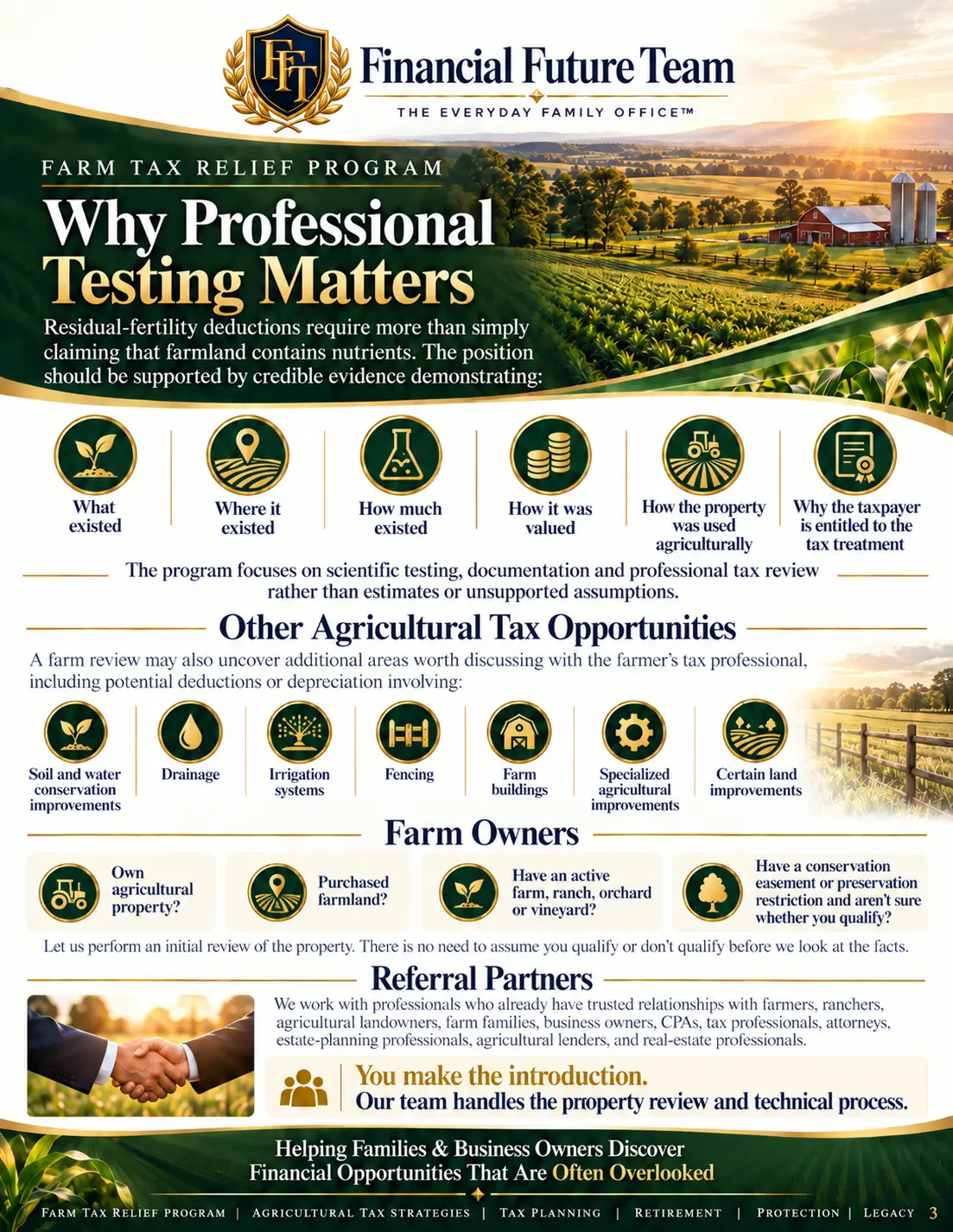
Why Professional Testing Matters
The testing, valuation, documentation, and professional review behind a defensible analysis.
 Open full-size page ↗
Page 4
Request a Preliminary Review
The property information needed to begin and what an initial review can help determine.
For farm owners and referral partners
Start with a preliminary farm review.
Bring the farm location, acreage, acquisition date, agricultural activity, ownership history, conservation restrictions, and any available property records.
Ask About My Property →This material is provided for educational purposes only and is not tax, legal, or accounting advice. Eligibility depends on the individual facts and circumstances of the taxpayer and property. No tax deduction, refund, or tax savings is guaranteed. Final tax treatment should be determined by the taxpayer’s CPA, tax attorney, or other qualified tax professional. Any residual-fertility analysis should be supported by appropriate testing, valuation, and documentation.